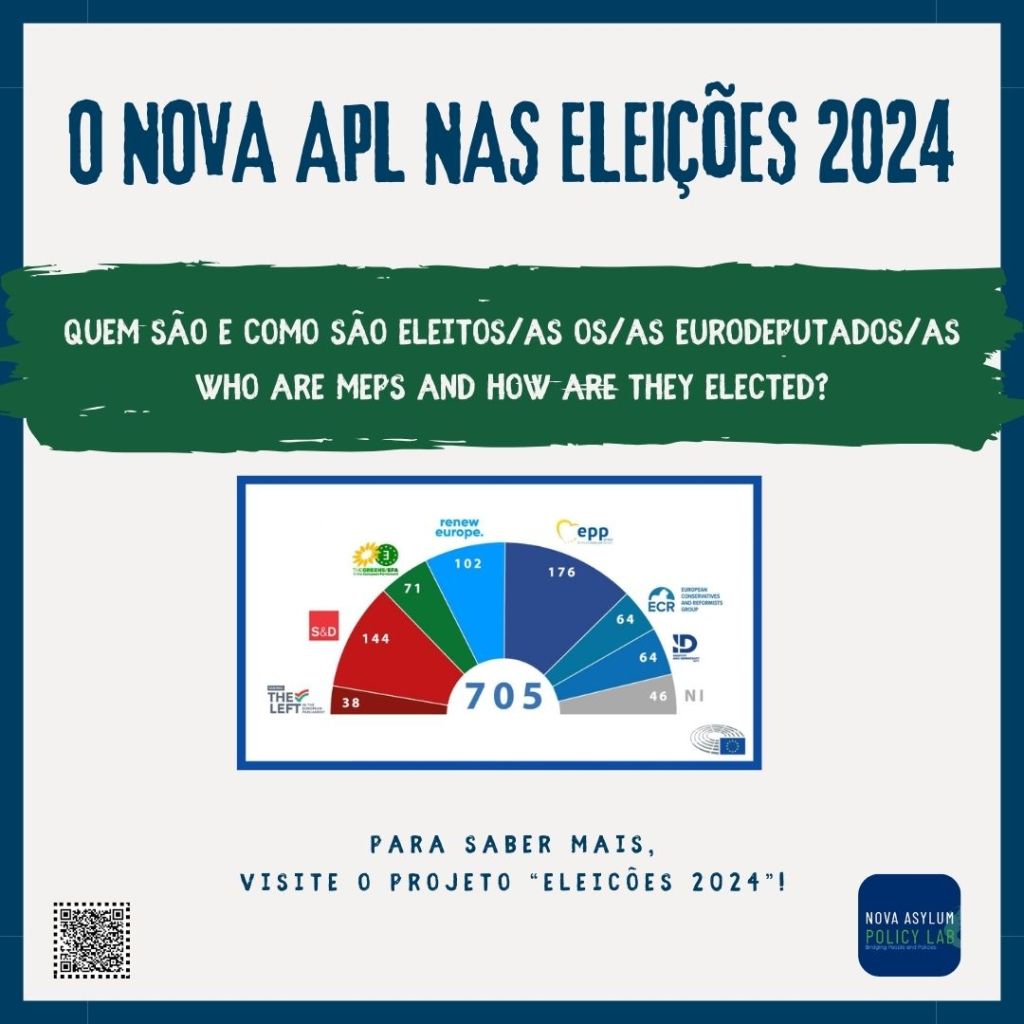
O Parlamento Europeu é composto por 705 Eurodeputados/as, eleitos por sufrágio universal direto a cada 5 anos, vindos dos 27 Estados-Membros da União Europeia.
A forma como o sistema eleitoral funciona é determinada por cada Estado-Membro, embora deva sempre ser garantida a igualdade de género, bem como o princípio do voto secreto.
Principais características:
- Representação proporcional de cada Estado-Membro: os assentos são distribuídos tendo em conta a população de cada Estado-Membro. Pouco mais de um terço dos/as Eurodeputados/as são mulheres.
- Existem atualmente 7 grupos políticos no Parlamento Europeu:
- Partido Popular Europeu (PPE): grupo de centro-direita e, atualmente, o maior grupo político no Parlamento Europeu.
- Aliança Progressista dos Socialistas e Democratas (S&D): grupo de centro-esquerda e o segundo maior grupo no Parlamento Europeu.
- Renew Europe (RE): grupo de centro, formado pela antiga Aliança dos Democratas e Liberais pela Europa (ALDE).
- Verdes/Aliança Livre Europeia (Verts/ALE): composto por partidos verdes e ambientalistas, bem como por partidos regionais e nacionalistas que promovem a autonomia regional.
- Identidade e Democracia (ID): grupo de direita e eurocético; é composto por partidos populistas, nacionalistas e antissistema.
- Conservadores e Reformistas Europeus (ECR): grupo de centro-direita, composto por partidos conservadores e reformistas.
- A Esquerda – Esquerda Unitária Europeia/Esquerda Nórdica Verde (GUE/NGL): grupo de esquerda, composto por partidos comunistas e socialistas.
- Os/as Eurodeputados que não pertencem a nenhum grupo político fazem parte do grupo dos/as Não Inscritos/as.

Como se organiza o trabalho do Parlamento Europeu?
Para preparar o trabalho do Parlamento Europeu em sessão plenária, os/as Eurodeputados/as distribuem-se em 20 comissões permanentes, cada uma delas especializada em domínios específicos.
As comissões parlamentares possuem de 25 a 88 Eurodeputados e têm um(a) Presidente, uma mesa e um secretariado, refletindo a composição politica do Plenário.
As comissões parlamentares reúnem-se uma ou duas vezes por mês em Bruxelas e os seus debates são públicos.
Factos interessantes sobre a legislatura 2019-2024, de acordo com o Parlamento Europeu:
- A maior taxa de participação dos últimos em 20 anos
- 61% dos/as Eurodeputados/as assumiram os seus cargos pela primeira vez.
- Deu-se um avanço notável na representação das mulheres, que compõem 41% dos/as Eurodeputados/as, um aumento significativo em relação à legislatura anterior.
- Redução da idade média dos/as Eurodeputados/as, com uma maior diversidade de faixas etárias representadas, incluindo a eleição da Eurodeputada mais jovem, aos 21 anos, e do Eurodeputado mais velho, aos 82 anos.
- Com um total de 751 Eurodeputados/as eleitos/as, o novo Parlamento Europeu reuniu sete grupos políticos, um a menos do que na legislatura anterior.
Na próxima legislatura, Portugal irá manter o mesmo número de assentos, ou seja, 21 Eurodeputados/as.

Referências:
- https://www.europarl.europa.eu/meps/pt/home
- https://www.europarl.europa.eu/topics/pt/article/20190705STO56305/factos-e-numeros-a-nova-legislatura-do-parlamento-europeu
[EN] The European Parliament is made up of 705 MEPs (MEPS = Members of the European Parliament), elected by direct universal suffrage every 5 years, from the 27 member states of the European Union.
The way the electoral system works is determined by each Member State, although gender equality must always be guaranteed, as well as the principle of secret ballots.
Main features:
- Proportional representation of each Member State: seats are distributed taking into account the population of each Member State. Just over a third of MEPs are women.
- There are currently 7 political groups in the European Parliament:
- European People’s Party (EPP): a centre-right group and currently the largest political group in the European Parliament.
- Progressive Alliance of Socialists and Democrats (S&D): centre-left group and the second largest group in the European Parliament.
- Renew Europe (RE): centre group, formed by the former Alliance of Liberals and Democrats for Europe (ALDE).
- Greens/European Free Alliance (Verts/ALE): made up of green and environmentalist parties, as well as regional and nationalist parties promoting regional autonomy.
- Identity and Democracy (ID): a right-wing, Eurosceptic group made up of populist, nationalist and anti-system parties.
- European Conservatives and Reformists (ECR): a centre-right group made up of conservative and reformist parties.
- The Left – European United Left/Nordic Green Left (GUE/NGL): a left-wing group made up of communist and socialist parties.
- MEPs who do not belong to any political group are part of the Non-Registered group.

How is the work of the European Parliament organised?
To prepare the work of the European Parliament in plenary session, MEPs are divided into 20 standing committees, each specialising in specific areas.
Parliamentary committees have between 25 and 88 members and have a Chairperson, a bureau and a secretariat, reflecting the political composition of the plenary.
The parliamentary committees meet once or twice a month in Brussels and their debates are public.
Interesting facts about the 2019-2024 parliamentary term, according to the European Parliament:
- Highest turnout in 20 years
- 61 per cent of MEPs took office for the first time.
- There has been a notable advance in the representation of women, who make up 41 per cent of MEPs, a significant increase on the previous legislature.
- A reduction in the average age of MEPs, with a greater diversity of age groups represented, including the election of the youngest female MEP at 21 and the oldest male MEP at 82.
- With a total of 751 MEPs elected, the new European Parliament brought together seven political groups, one fewer than in the previous legislature.
In the next legislature, Portugal will retain the same number of seats, i.e. 21 MEPs.

References:
- https://www.europarl.europa.eu/meps/pt/home
- https://www.europarl.europa.eu/topics/pt/article/20190705STO56305/factos-e-numeros-a-nova-legislatura-do-parlamento-europeu
Project Team | Equipa do Projeto:
Emellin de Oliveira & Ana Cansado
Rita Martins de Sousa & Ana Pedro Martins
Project Duration | Duração do projeto:
From December/23 to June/24 - De dezembro/23 a junho/24
 NOVA Asylum Policy Lab