

[PT] No n.º 1 do art. 13.º do TUE está prevista uma lista nominativa das Instituições da União Europeia (UE), que visam “promover os seus valores, prosseguir os seus objetivos, servir os seus interesses, os dos seus cidadãos e os dos Estados-Membros, bem como assegurar a coerência, a eficácia e a continuidade das suas políticas e das suas ações
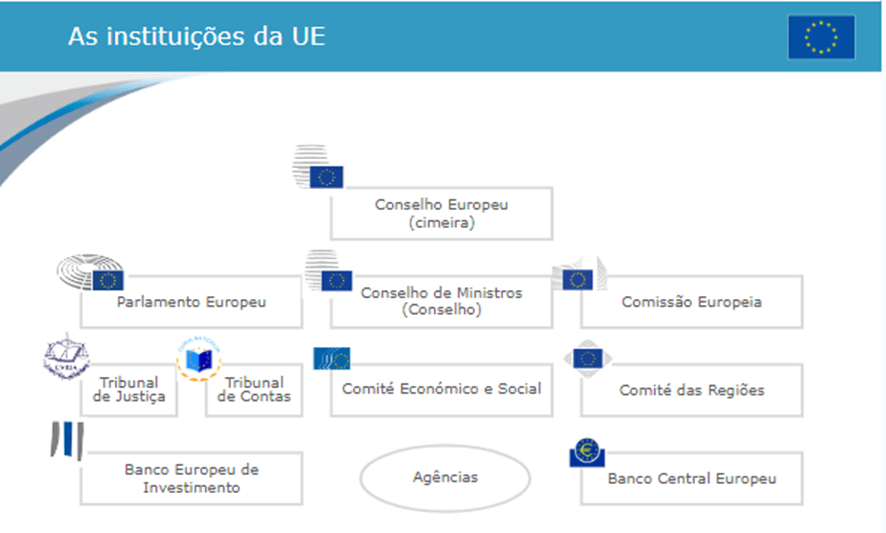
Sendo uma das principais instituições da UE, a interação do PARLAMENTO EUROPEU (PE) – art. 14.º do TUE – com as outras instituições europeias é fundamental para o funcionamento do sistema político da UE.
Vejamos algumas destas interações:
CONSELHO EUROPEU (arts. 15.º e 18.º do TUE):
- O Conselho Europeu é composto pelos Chefes de Estado ou de Governo dos Estados-Membros e pelo Presidente da Comissão Europeia.
- Embora não tenha poder legislativo, é esta instituição que define as prioridades políticas gerais da UE e orienta o seu desenvolvimento.
- O PE não faz parte do Conselho Europeu, mas o Presidente do Parlamento Europeu é convidado a participar nas reuniões para apresentar as posições do PE.
- Depois de cada Cimeira, o Presidente do Conselho Europeu apresenta um relatório ao PE sobre os seus resultados.
CONSELHO DA UNIÃO EUROPEIA (art. 16.º do TUE):
- O Conselho da UE representa os Governos dos Estados-Membros e desempenha um papel importante nas tomadas de decisão e na aprovação da legislação.
- O PE e o Conselho co-legislam juntos. Ambos debatem e emendam propostas legislativas antes de serem adotadas como atos legislativos da UE. Além disso, negociam acordos internacionais em conjunto.
- No início e no final de cada Presidência semestral, o Presidente do Conselho da UE debate o programa com os Eurodeputados, que podem apresentar perguntas orais e escritas e solicitar-lhe que inicie ou priorize novas orientações políticas.
COMISSÃO EUROPEIA (art. 17.º do TUE):
- Enquanto instituição executiva da UE, é responsável por propor nova legislação e pela execução das decisões do PE e do Conselho da UE.
- É o PE que tem de aprovar a constituição da Comissão, tendo também o poder de a destituir;
- O PE assegura assim o controlo democrático da Comissão, que apresenta regularmente relatórios ao PE, incluindo um relatório anual sobre as atividades da UE e sobre a execução do orçamento.
- Mais ainda, o PE pode convidar a Comissão a lançar novas políticas e propostas de legislação.
- A nomeação do/a Presidente da Comissão é realizada com base nos resultados das eleições ao Parlamento Europeu, após a apresentação de um candidato principal por cada grupo político, que devem ser submetidos à aprovação do PE.
TRIBUNAL DE JUSTIÇA DA UNIÃO EUROPEIA – TJUE (art. 19.º do TUE):
- O TJUE é responsável por interpretar o direito da União Europeia, garantindo que este seja aplicado da mesma forma em todos por todos os Estados-Membros da EU, bem como pelos órgãos, organismos e instituições.
- Ainda, delibera sobre diferendos jurídicos entre Governos nacionais e Instituições Europeias.
- O PE pode requerer ao TJUE que tome medidas contra a Comissão ou o Conselho, caso atuem de forma contrária ao espírito do direito da UE.
- O PE, juntamente com o Conselho, pode também requerer ao Tribunal de Justiça a criação de tribunais especializados.

Em resumo, o Parlamento Europeu desempenha um papel fundamental na legislação, supervisão e no equilíbrio de poder entre as instituições da UE, trabalhando em conjunto com outras instituições para assegurar e moldar o futuro da União Europeia.
Referências:
- https://eurocid.mne.gov.pt/artigos/relacoes-com-outras-instituicoes-da-ue
- https://www.europarl.europa.eu/factsheets/pt/sheet/12/competencias-do-tribunal-de-justica-da-%20uniao-europeia
- https://www.ffms.pt/pt-pt/direitos-e-deveres/quais-sao-os-orgaos-dirigentes-da-uniao-europeia
- https://eurocid.mne.gov.pt/artigos/relacoes-com-outras-instituicoes-da-ue
- https://www.europarl.europa.eu/factsheets/pt/sheet/12/wlasciwosc-trybunalu-sprawiedliwosci-unii-%20europejskiej%C3%82%C2%A0
[EN] Article 13(1) of the TEU provides a list of the institutions of the European Union (EU), which aim to ‘promote its values, pursue its objectives, serve its interests, those of its citizens and those of the Member States, and ensure the consistency, effectiveness and continuity of its policies and activities’.

As one of the EU’s main institutions, the EUROPEAN PARLIAMENT‘s (EP) – Art. 14 TEU – interaction with the other European institutions is fundamental to the functioning of the EU’s political system.
Let’s take a look at some of these interactions:
EUROPEAN COUNCIL (arts. 15 and 18 TEU):
- The European Council is made up of the Heads of State or Government of the Member States and the President of the European Commission.
- Although it has no legislative power, it is this institution that defines the EU’s general political priorities and guides its development.
- The EP is not part of the European Council, but the President of the European Parliament is invited to attend meetings to present the EP’s positions.
- After each summit, the President of the European Council presents a report to the EP on its results.
COUNCIL OF THE EUROPEAN UNION (Art. 16 TEU):
- The Council of the EU represents the Governments of the Member States and plays an important role in decision-making and the adoption of legislation.
- EP and the Council co-legislate together. Both debate and amend legislative proposals before they are adopted as EU legislative acts. They also negotiate international agreements together.
- At the beginning and end of each six-month Presidency, the President of the Council of the EU discusses the programme with MEPs, who can submit oral and written questions and ask him to initiate or prioritise new policy guidelines.
EUROPEAN COMMISSION (Art. 17 TEU):
- As the EU’s executive institution, it is responsible for proposing new legislation and for implementing the decisions of the EP and the Council of the EU.
- It is the EP that has to approve the constitution of the Commission, and it also has the power to dismiss it.
- EP thus ensures democratic control of the Commission, which regularly reports to the EP, including an annual report on EU activities and the implementation of the budget.
- Furthermore, the EP can invite the Commission to launch new policies and proposals for legislation.
- The appointment of the President of the Commission is made on the basis of the results of the elections to the European Parliament, following the presentation of a leading candidate by each political group, which must be submitted to the EP for approval.
COURT OF JUSTICE OF THE EUROPEAN UNION – CJEU (Art. 19 TEU):
- CJEU is responsible for interpreting European Union law, ensuring that it is applied in the same way by all EU Member States, as well as by bodies, organisations and institutions.
- It also rules on legal disputes between national governments and European institutions.
- EP can ask the CJEU to take action against the Commission or the Council if they act contrary to the spirit of EU law.
- EP, together with the Council, can also ask the CJEU to set up specialised courts.

To summarise, the European Parliament plays a key role in legislation, oversight and the balance of power between EU institutions, working together with other institutions to secure and shape the future of the European Union.
References:
- https://eurocid.mne.gov.pt/artigos/relacoes-com-outras-instituicoes-da-ue
- https://www.europarl.europa.eu/factsheets/pt/sheet/12/competencias-do-tribunal-de-justica-da-%20uniao-europeia
- https://www.ffms.pt/pt-pt/direitos-e-deveres/quais-sao-os-orgaos-dirigentes-da-uniao-europeia
- https://eurocid.mne.gov.pt/artigos/relacoes-com-outras-instituicoes-da-ue
- https://www.europarl.europa.eu/factsheets/pt/sheet/12/wlasciwosc-trybunalu-sprawiedliwosci-unii-%20europejskiej%C3%82%C2%A0
Project Team | Equipa do Projeto:
Emellin de Oliveira & Ana Cansado
Rita Martins de Sousa & Ana Pedro Martins
Project Duration | Duração do projeto:
From December/23 to June/24 - De dezembro/23 a junho/24
 NOVA Asylum Policy Lab